
Environmental concern and communication are declining but green purchasing continues to grow
Chris Coulter believes a new sustainability narrative is emerging amid what he calls the ‘green purchase paradox’
 Chris Coulter is the CEO of sustainability advisory firm GlobeScan
In a time when sustainability feels increasingly politically charged and brand communications are becoming more cautious, GlobeScan research reveals a surprising contradiction: consumers are buying more environmentally-friendly products even as they hear less about sustainability from brands.
This article draws on findings from GlobeScan’s 2025 Healthy & Sustainable Living study, conducted across 33 markets and territories (n=31,960). The research was carried out in July and August 2025, and offers a timely lens into how consumer motivations are evolving.
What we are seeing is what we call the Green Purchase Paradox: concern and communication are declining, yet green purchasing continues to grow.
The rise of greenhushing, and its impact on consumer engagement
Sustainability communication has entered a period of retreat. Greenhushing is now firmly in place, marking a sharp departure from where we were just a few years ago.
Globally, there has been a 14-point drop in the share of consumers who report having heard, read, or seen “a great deal” or “some” messaging from brands about their environmental efforts.
Equally concerning, consumer trust in sustainability messaging from businesses has fallen by 14 points, highlighting the growing challenge for brands to engage audiences authentically on environmental issues.
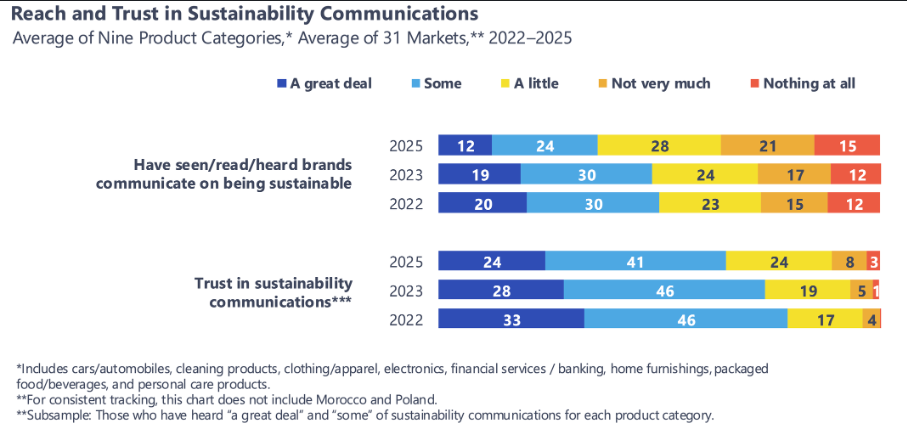
Implication
Greenwashing regulation, populist politics, and heightened scrutiny of corporate sustainability claims have increased the perceived risks of speaking openly about sustainability. As brands become more cautious, consumer concern about environmental issues softens and feelings of empowerment decline.
When brand engagement becomes muted, it doesn’t create neutrality, it creates disengagement. The absence of visible leadership dampens enthusiasm and weakens sustainability as a cultural signal.
Consumers are buying green anyway
Despite this pullback in sustainability communications, consumer behaviour is moving in the opposite direction.
Globally, 56% of consumers now say they purchased an environmentally-friendly product or service in the last month. That represents a six-point increase in just one year. With a sample of over 30,000 people, this shift is statistically robust and visible in every market we track except Egypt and Hong Kong.
This is not a local or niche trend. It is a global phenomenon.
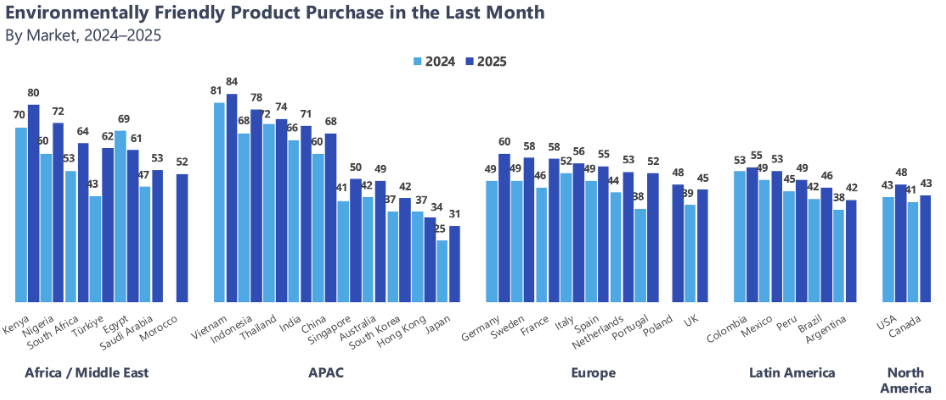
This counter-intuitive pattern signals a shift from extrinsic motivation to intrinsic motivation. In other words, consumers are relying less on what brands tell them and more on what feels personally relevant and valuable.
Ongoing cost-of-living pressures, a narrowing of personal priorities, and a desire for individual agency are reshaping demand. Sustainability is increasingly embedded in expectations around:
- Quality
- Safety
- Health
- Wellbeing
Brands that deliver on these fundamentals are benefiting, even without explicitly leading with environmental claims.
The real driver: Wellbeing, not environmental concern
To understand what sits beneath the Green Purchase Paradox, we need to look at how sustainability and health now intersect in people’s lives.
Post-pandemic, consumers have undergone a recalibration around self-care and wellbeing, and this is reshaping how sustainability shows up in decision-making. Our data shows that:
- 65% of consumers globally are interested in both environmental protection and healthier lifestyle changes.
Health and sustainability are no longer parallel agendas. They are increasingly fused in consumer desire.
To test what actually drives sustainable behaviour, we applied ‘structural equation modelling’ – a statistical method that helps us understand how different factors influence each other across complex systems – to our full global dataset.
The result was clear and consistent:
- Concern about the environment is not a strong predictor of sustainable behaviour.
- Health and wellbeing are the primary drivers of action.
Implication
We are witnessing a decoupling between environmental concern and purchasing behaviour.
Environmental concern is becoming entangled with political tension, social polarisation, and a sense of powerlessness. Purchasing behaviour, however, remains an area of personal agency. It is where people feel they can still make a difference in their own lives.
Sustainability is being carried forward not by activism alone, but by self-interest aligned with wellbeing.
This points to a new narrative for sustainability: Better for you, better for the planet.
Health and environmentalism will increasingly become axiomatic – two sides of the same value system.
Conclusion: a new sustainability narrative is emerging
The Green Purchase Paradox is not a contradiction, it’s a signal.
Sustainability is not disappearing from consumer life. It is changing shape. It is becoming quieter, more personal, and more closely tied to wellbeing, quality, and safety.
For brands, this creates both risk and opportunity:
- Silence can weaken trust and cultural momentum
- But relevance can be rebuilt through health, quality and human benefit
The future of sustainability engagement will belong to organisations that understand this shift and act on it with confidence. Not by retreating further, but by evolving the story they tell, from sacrifice and concern, to care, empowerment and everyday value.