
Carlsberg CSO: ‘Being clear on something as messy as sustainability is the most difficult thing in the world’
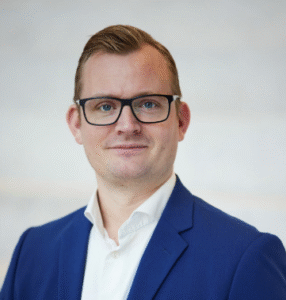 Simon Boas Hoffmeyer discusses the brewer’s new decarbonisation goals, and how difficult it is to communicate them.
At first glance, Carlsberg’s recent decision to push its decarbonisation deadline back looks like another company backtracking on sustainability.
The Danish brewer announced in March that its 2030 targets were moving to 2032, following the addition of nearly a million tonnes of carbon to its ledger as a result of its acquisition of Britvic.
But Carlsberg’s global head of sustainability, Simon Boas Hoffmeyer, says its new goals are stronger than ever.
“I can look you straight in the eye and say we’ve never had more ambitious targets,” he tells Real Economy Progress.
Communicating that can be a challenge, though, he admits.
“Being clear on something as complex and messy as sustainability is the most difficult thing in the world,” says Boas Hoffmeyer.
Some of the frustrations faced by companies like Carlsberg stem from the fact that, as they fall in line with globally-recognised standards or best practices, they have to express their ambitions differently; and, at the headline-level, that can look like retreat.
Take the firm’s Scope 1 and 2 goals.
Originally, Carlsberg planned to have no emissions generated by its breweries by 2030, excluding its logistics activities.
Its revised target now commits it to a 90% reduction in its own operations by 2032.
Apart from the additional two years, Boas Hoffmeyer says there’s no shift in the goal – despite the stated level of decarbonisation changing from 100% to 90%.
“It’s the exact same target but expressed in the language of the Greenhouse Gas Protocol,” he says.
The GHG Protocol demands that all Scope 1 and 2 emissions are included in the denominator when setting a target, meaning Carlsberg’s previously-excluded logistics have to be added in.
This brings the proportion of decarbonisation down to 90%, without any actual change in ambition.
Boas Hoffmeyer suggests the new target is arguably more ambitious, since it now includes Britvic’s emissions, too.
“The devil is always in the detail,” he says. “But sometimes this is incredibly difficult to articulate.”
Carlsberg’s Scope 3 target is also more ambitious than it first appears.
The firm has swapped its goal of cutting value-chain emissions intensity by 30% by 2030 for an absolute Scope 3 reduction of 31% by 2032.
“For someone who is not an expert in carbon accounting, they might think it’s virtually unchanged, but it’s actually a completely different ball game now,” he says, adding that Carlsberg must now “counterbalance every single bit of growth with [carbon] reductions”.
“That means the challenge is an order of magnitude bigger.”
Boas Hoffmeyer tells Real Economy Progress that anyone who underestimates the scale of the challenge posed by measuring and reducing Scope 3 emissions “either does not know their data, or is delusional”.
Carlsberg undertook its first Scope 3 analysis back in 2008, and was among the first companies to set Science Based Targets initiative-approved targets, in 2017.
“For me, being early is a prerequisite to driving change because unfortunately, with many sustainability areas, change is counted in decades and not in months,” he says.
The company’s ownership structure is one of the reasons it can be so forward-looking – most of its voting rights are held by the Carlsberg Foundation, not conventional shareholders.
“This means that sometimes I’m able to make long-term decisions in a way that a fully-listed company probably isn’t,” observes Boas Hoffmeyer.
He’s not the first to point out that unlisted companies can have more sovereignty to pursue their sustainability ambitions: last year, Lego’s chief sustainability officer, Annette Stube, pointed to its ownership model as a key driver of its commitments.